Whitehallcollies

Unique features of the Whitehall Collies: white collies

What are the unique features of your breeding program’s methods and processes?

Whitehall Collies Breeding Best Practices 1. We only keep a few dogs at a time. I decided from the beginning that all our Collies would live in the house with us.  The Collie is so emotionally attuned to his people that isolating one in an outside pen with little human contact seemed cruel to me.  I know other breeders manage this somehow, and humanely, but I just can’t do it. So…we operate under limitations regarding the number of dogs we can have here at one time.  As I write this, we have six.  The upside is that our dogs aren’t just socialized – they seem almost human.  The Collie is exceptionally high in “emotional IQ.”  In relating to humans, they are uncannily sensitive to our moods, body language, and tone of voice. That’s what makes them such excellent companion dogs. Keeping them in isolated quarters, other than occasionally confining them to a crate overnight or crate training a puppy, frustrates this fundamental instinct in a Collie. I like having a manageable number of dogs, too, because I can handle the level of care they deserve from me as their solo caregiver (my husband helps out too.) 2. We focus on natural nutrition. The dog food industry is largely unregulated.  For every dog food recall you hear about, somebody’s pets have died from eating the food. I once read that bloody sawdust from the floor of a slaughter facility can be counted as “crude protein” on a dog food label!  Okay, that was enough for me. I feed my group a hybrid diet of raw, fresh, and a high quality kibble.  Recently I have begun to add FreshPet to our diets with good results. My raw recipe is a mixture of a raw egg, mackerel, canned pumpkin or ground carrots & apples, cooked liver, beef kidney, and various animal muscle meats – pork, poultry, beef, and venison if I can get it. I make a raw “topper” and freeze in containers in advance for everybody.  That’s 150 meals a month.  I enjoy my Collies’ shiny coats, healthy skin, and clean teeth.  This diet also reduces the volume of their defecation, which is small, hard, and almost odorless in a raw-fed dog.  I’d rather make dinners than pick up the poops from a pack of large dogs in the yard! I’m not a purist about this. I add some kibble to each dish (we currently feed Purina Pro Plan.) The kibble is for carbs.  Carbs are a controversial topic among raw feeders, but my professional handlers tell me lovely coats grow better if there is at least some kibble in the diet. And since my raw/fresh formulation makes up the main part of the meal, I know they are getting great nutrition. 3. We have a complete grooming setup, and we start the puppies on grooming table etiquette when they are still tiny! I have a “beauty parlor” on the Dog Level of my house, right next to the Whelping Room. I do all my own bathing and grooming. Going over each dog from nose to tail shows me any issues as soon as they start. Prevention is better than cure, as they say. The baby puppies start nail clipping right in the whelping box at one week of age, once a week.  Their little nails are needle-sharp and can scratch Mom as they nurse, and I want her to nurse her babies as long as it’s comfortable for her. Everyone in the litter gets grooming table time starting at four weeks, to give them a positive start on a discipline they will need for the rest of their lives.  As my puppies grow, I will brush them with a soft baby brush so they get used to the sensation.  Then we will start with Dremel Training.  The puppies must permit their nails to be ground, and the sound and the vibration takes some getting used to. My secret here is peanut butter! I start taping ears when puppies reach six to eight weeks of age.  That forward tipping of Collie ears rarely comes naturally and contributes mightily to the lovely Collie expression. I train new Collie owners, too! Attention, attention, and more attention. Yes, all this would spiral out of control if I tried to keep every pretty Collie that has tempted me!  That is why I keep my census of adults low and only breed one to two litters per year.  Happy, healthy, sociable, mannerly, and oh-so-loved. 4. What makes your breeding program compete effectively with other breeders? You know, I don’t compete against other breeders. Among Collie breeders, those who are members of the Collie Club of America, there is a camaraderie. That’s because we all, at one time or another, need the help of other breeders. Also, the shared experience and encouragement of other breeders when we have a nice win or a pretty litter of pups helps through the tough times. Every breeder has their unique vision of the perfect Collie, and within the guidelines of the Collie Standard, each is a little different.  Some prospective Collie owners will be attracted to the energetic and athletic Collie whose parents have an alphabet soup of performance titles behind their names! Others might be looking for a calm beauty to grace their couch, or a bouncy, playful dog that will entertain their kids.  Collies come in all those categories. So, to whom might a Whitehall Collie appeal? Judging from the homes graced by a Whitehall Collie in the past nine years, most were looking for a healthy, happy puppy with classic Collie “type” and an endearing, charming personality that makes them a dream to have in their home. That’s what I was looking for when I went searching for our first Collie, and that’s what I breed for today.   5. What original bloodlines gave you your start to create the Whitehall line? Early on in my Collie breeding adventure, I was attracted to the style and temperament

What are the unique features of your breeding program’s methods and processes? Read More »
What you may not know about Show Collie Breeders

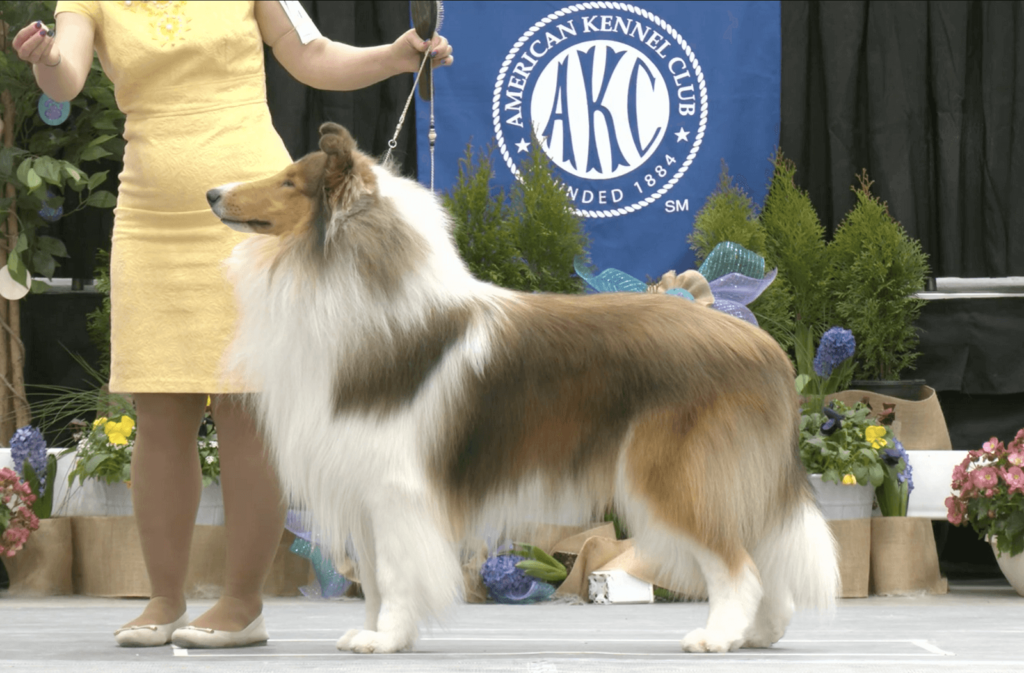
I frequently hear the following from people looking for a Collie puppy: “I’m not looking for a show dog, just a good dog.”I get that! But I think under that comment might lie a few misconceptions about show Collies vs. pet Collies. All our “show prospects” are pets primarily. They live in my house just like any other dog. Some may think that show breeders are concerned about appearance only. They may think that purchasing a puppy from a show breeder means paying an inflated price to buy traits that aren’t important to them. They may even think that show dogs are just fancy airheads!A successful show dog – which is what we are breeding for – must be free of harmful genetic conditions, have a confident happy temperament, be very trainable (intelligent), resilient in many surroundings and not prone to illness. All requirements for a great family companion! About price and the show Collie prospect: Collies mature slowly and change a lot along the way. Because of that, we can select “promising” puppies for the show ring but there is no guarantee the pup will grow into a show dog. At Whitehall, our pricing for show potential puppies and companion puppies is the same. Each puppy represents the same superior genetics, the same financial investment, and the same effort in raising. And they are all beautiful! Since you are not paying any extra for the beautiful part, it’s a nice bonus, don’t you think? A Note about Genetics and Expectations The mature Rough Collie can be so stunning, you will find yourself in the middle of an admiring crowd whenever you take them out in public! But if not expressly bred for those attention-getting virtues, a Collie won’t have them. Genes always have to come from somewhere! Two blue merle Collies: Same breed, just bred differently. The crowning glory and distinctiveness of the Rough Collie is it’s luxurious coat and dramatic outline – from the intelligent, lovely expression and abundant snow-white ruff to the poufy white-tipped tail. This look has to be persistently selected for, bred from show ring stars. Show dog breeders guard their genetics closely, just as a corporation guards their brand. They do not sell breeding rights to their dogs, and they do not sell their best prospects to commercial or hobby breeders. Beware of online Collie puppy sellers who maintain a few “breeding pairs” and mate the same dogs together repeatedly. That is not how beautiful Collies are made, and you will be disappointed if you buy one of their advertised puppies, expecting that traffic-stopping “look” that well bred show Collies have. Most online pet breeders have obtained their breeding stock from other pet breeders. It isn’t their goal to breed Collies that gather crowds. So they don’t. At Whitehall we search the country for studs that best complement our girls, that will add virtues to the mix, so each generation is better than the last. Rarely would a male in our yard qualify for our own matings, since they are of the same family as our girls. The process of acquiring superior genetics from outstanding studs who live hundreds or thousands of miles away is very expensive! But a breeder who is willing to do that, when required, to improve their stock displays the passion and commitment it takes to aspire to consistently produce healthy, well-tempered, breathtaking Collies. The kind we hope goes to live at your house! Key Points: Show dog breeders are breeding for the very traits you want most in a companion dog/family member. Successful, reputable show dog breeders are willing to invest large amounts of money and effort in their dogs, which is what it takes to achieve their goals. They will not compromise or cut corners with their breeding program, or with care of their dogs. Their reputation means everything! Successful show dog breeders submit their dogs to genetic testing, examinations required for certifications, and adhere to a Statement of Ethics as a condition of their membership in their National and State Breed Clubs. Successful show dog breeders are not lone practitioners, but members of a community of like-minded breeders, continually learning and helping each other improve their breeding programs. Successful show dog breeders will be very particular about qualifying homes for their puppies, which is more important to them than merely “making a sale.” They will also stand behind each puppy they sell, offering a health guarantee. As an owner, you will have a wise and experienced advisor, supporter, and advocate for the life of your dog. 

What you may not know about Show Collie Breeders Read More »

More Fun Facts About Collies

More Fun Facts About Collies The Collie is a medium to large herding dog that comes in two varieties: the Rough Collie familiarized by the Lassie TV series, and the Smooth (short-haired) Collie. American Rough and Smooth Collies are distinct varieties; though they are routinely crossed together in the US, their puppies are either Rough or Smooth, not somewhere in the middle. Collie colors include sable & white, tricolor, blue merle, sable merle, and white. All colors except white display the classic Collie pattern of a white collar, white chest and underside, white paws and tip of the tail. White Collies have typical coloration on their head, and may have body spots of color as well. Collie puppies weigh in at around 12-18 lbs by the time you bring one home from the breeder. In the Rough variety, the fur continues to grow into a fluffy “puppy coat” until the dog is over a year of age. Our females experience their first heat cycle at anywhere from 8 -14 months, and shed 2-3 months after a cycle. Males usually shed once a year, around their birthday. Collies’ skeletal system is not fully mature until the growth plates close, after 2 years of age. For this reason we ask our puppy families to refrain from de-sexing their Collie female until after her second heat cycle. The males do not need to be neutered at all unless there is an intact female in the home, or annoying sex-related behaviors such as marking in the house. If you do neuter a male, it is best to leave him intact until after his third birthday. Note: de-sexing a Collie is likely to cause changes in the dog’s coat which may make it harder to manage. This is most noticeable in males. The undercoat does not moult completely, making it thicker and more prone to matting. See my article Controversial Topics for more in-depth information. Their herding instinct is fairly strong, which causes them to display “gathering” behaviors, even toward humans. It can be amusing, like the time our first Collie circled a group of our toddler grandchildren as they entered their playhouse, and then he laid across the door! “Penned ‘em!” Herding dogs are bred to lower their prey drive and elevate nurturing instincts, in order to tend stock rather than attack them. This shows up in your Collie as a willingness to befriend other pets in the house, and a particular protectiveness toward small children. Some herding-inspired behaviors, though, like heel-nipping, are not desirable and need to be discouraged the moment they appear. Since the Collie is extremely sensitive to human emotions, discipline needs to be firm but gentle. Shouting at, or striking, a Collie needs never be done to get the point across. Collies have an intense desire to please their humans, and while not “one man dogs”, they are extremely loyal. All puppies are rambunctious and playful, but Collies are not known to be crazy, rowdy, rough or uncontrollable. For this reason they are ideal companions for families with little ones, and older people. They are not used as guard dogs, in that they are non-aggressive, but they do have keen hearing and a “big dog bark” that scares away intruders. 

More Fun Facts About Collies Read More »

Whitehall Collies’ Position on Controversial Topics of Puppy and Dog Care

Whitehall Collies’ Position on Controversial Topics of Puppy and Dog Care We all want to do the best thing for our dogs. There is a lot of mixed advice out there, and we just have to sift through it and make choices based on our own circumstances, and do the best we can. It is important to do the research, though, and not just do what’s convenient. Some of our dog care decisions can literally mean life or death for our dogs. Following are my recommendations (which are just that) based on my experiences with my own dogs, reading, and interacting with other collie breeders. Q. What is the best age to pick up our puppy?A. Nine weeks or later. Collies are slow maturing, and may not have good bladder control until that age. Also, they are very social dogs and learn much from being in the company of their mother, their mother’s “pack”, and their siblings. Taken too early, your puppy could frustrate you with “accidents”, inadvertent biting, and other quirks that are completely preventable if simply left with mom a week or two longer. As for bonding, collies bond very easily with humans, even into adulthood, as long as they have been treated kindly. Q. Do you have a spay/neuter contract? At what age should we spay or neuter our puppy?A. Many breeders enforce a spay/neuter contract to protect themselves from people breeding animals they deem unsuitable for breeding, and to discourage people from purchasing puppies to make profit centers out of them rather than beloved pets. We sell our companion animals on AKC Limited Registration, which just means offspring of that animal cannot be registered, and feel this protects our kennel name. We require new owners to sign a contract stating that they will not transfer their dog to a third party without our knowlege and consent, and never to transfer their collie into shelter or rescue, but return the dog to us if for any reason they can’t keep it. So much for the breeder’s interests; there are medical questions about spay/neuter that are compelling. As I mentioned, collies are slow to mature. Males are not fully mature until they are three; females just a little earlier. As a large breed, this means their skeleton is not “finished” until this age. Spay/neuter deprives an animal of its sex hormones, which play a delicate balance in all the functions of the body. If you de-sex a young dog, it will never grow normally after that, and you can’t undo the damage. Therefore I encourage owners to refrain from this operation until at least two years of age, or after two heat cycles in the female. Yes, there is a little inconvenience dealing with a discharge when the female is in heat, but it is only noticable for a week or so and a pair of britches with a pad in it is all you need when she is indoors. Bitches are only fertile for 4-6 days during the cycle, so guarding her virtue is not a three week proposition. As far as “irresponsible accidental breedings”, it is not that big a problem. If you do not allow your dog to run loose, and you do not keep a female in heat housed with an intact male (of any breed or size), you will not have an accidental litter. Males may never need to be neutered at all, if you never let them run loose – which is just common sense anyway. One option for the females is OSS (Ovary Sparing Spay). This keeps hormones in balance but the uterus is removed, so even though she will still have heat cycles, there is no discharge and she can’t get pregnant. Only select vets perform this surgery and it is more expensive than a routine spay, but there are many advantages. As a side note, grooming the neutered collie becomes a little more difficult, especially in full-coated males. The undercoat becomes more “cottony” and matts more easily. And a collie shouldn’t be shaved, unless for medical reasons. Spayed female collies often experience urinary incontinence when they get older, but there are medications to help with that. Spaying alleviates the risk of their developing Pyometra, a uterine infection that can be fatal and sometimes has no symptoms (closed pyo). Older Collie females are prone to developing pyometra, so spaying (even OSS) alleviates that risk. Intact males can develop testicular cancer, but the risk is generally low. The takeaway is this: do not de-sex your puppy at a young age, no matter what your vet tells you. Collies are not oversexed or a breed that likes to wander, and they are slow to mature. Just don’t do it as a matter of course;consider the reasons and make an educated and compassionate decision. Q. What should we feed our puppy?A. Purina Pro Plan Puppy kibble, mixed with goat milk. Powdered goat milk mixed with warm water is a less expensive alternative to fresh goat milk. Cow’s milk is too difficult for young puppies to digest. You can switch to moistening the kibble with canned Purina puppy food after a month or two. That’s the convenient answer. What is the optimum nutrition for your dog?Personally, I feed raw dog food I make myself. This takes some commitment and I know it’s not for everybody. I do it for the following reasons:a. I am in complete control of what they are eating, so if there are ever any allergies or reactions to the food it’s easy to isolate. I can also examine each ingredient myself and toss anything suspect, and it’s all human-grade.b. I never have to fear my dogs becoming a statistic in a dog food recall, of which there have been many.c. I don’t have to have my dogs’ teeth professionally cleaned every year. I only do it rarely.d. They maintain optimum weight and great muscle tone without trying.e. Their fur is always shiny and healthy.f. If I have correctly balanced

Whitehall Collies’ Position on Controversial Topics of Puppy and Dog Care Read More »

Collie Health and Genetics

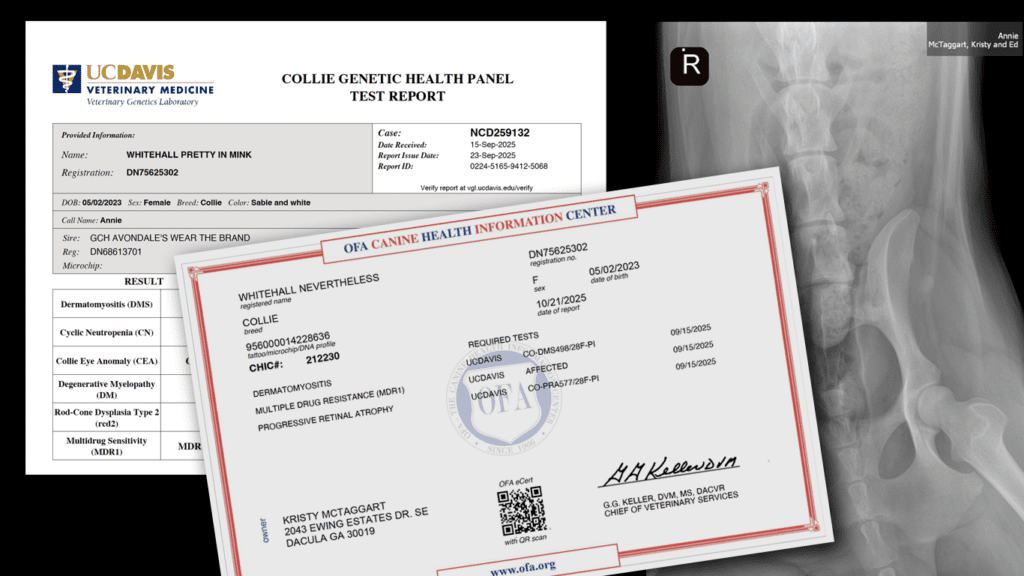
We Collie breeders take genetic testing very seriously, seeing what devastation mutations in overbred dog populations can cause. Our parent club, the Collie Club of America (CCA), formed a 501(c)3 nonprofit organization called the Collie Health Foundation in 1986. It aims to address the breed’s most significant health problems with research, testing, and education. CHF has granted over one million dollars to research that benefits all breeds of dogs, but our primary attention goes to serious diseases that have cropped up in Collies in the past:  Bloat, Grey Collie, Epilepsy, eye diseases (most notably PRA), Dermatomyositis,  and Degenerative Myelopathy.  Collie breeders can understand their transmission and breed away from these conditions through the reports produced by our research grantees, combined with thorough genetic testing. We have done so with much success. What kinds of genetic testing do you do? I send DNA samples of all our breeding dogs, and retained puppies, to UCDavis for a customized panel designed in cooperation with our Collie Health Foundation. The testing addresses mutations of concern to the Collie breed, including PRA, CEA, Grey Collie, DMS, DM, and MDR-1. The report from the parents is available to anyone interested in a Whitehall puppy. The information helps me choose knowledgeably for my breeding program. If a prospective puppy buyer wants this testing done on their choice puppy, we are happy to comply.  However, if I know genetic reporting on the parents, I can clear the puppies “by pedigree” from the few dangerous known genetic mutations Collies can have. A Note About Eyes One misunderstood condition Collies carry is Collie Eye Anomaly (CEA), also called Choroidal Hypoplasia.  It is indicated by small pits in the inner surface of the back of the eyeball.  Most Collies have a minor version of this genetic anomaly.  It does not affect their vision and does not get worse over time.  As an ethical Collie breeder, I commit to testing each puppy at eight weeks of age when a veterinary ophthalmologist best detects this condition.  I furnish the results of this test to the puppy’s buyer.  If anything is detected compromising normal vision, the buyer is informed before committing to buy the dog.  In our particular bloodline, I have only encountered an issue once (a dystichia, or misplaced eyelash.)  The puppy grew out of it and is normal. Normal Eyes Some breeders in the US, and many in Europe, emphasize breeding “normal-eyed” Collies. I applaud that, but I don’t select against mild CEA in my breeding program, and here’s why.  CEA is a condition carried by 70-80% of Collies.  It does not affect their longevity, vision, or quality of life. Disqualifying otherwise healthy breeding stock who carry the CEA gene would result in a whole lot of inbred Collies. To keep our gene pool diverse and healthy, I, and many other Collie breeders, focus on breeding away from deleterious mutations that impact a Collie’s quality of life. MDR1 (Multidrug Sensitivity) Herding breeds share a mutation that lowers the ability to clear certain drugs from their system. Among them are ivermectin, some of the anesthetics for surgery, and some cancer treatment drugs.  We do test for the mutation in all breeding stock.  We also treat every Collie as though it is affected, because many are.  So, I avoid all the drugs deemed a threat to herding dogs.  It is easy to do because there are safe substitutes available. I provide every puppy buyer with a list of these potentially harmful drugs.  Most veterinarians are up to speed on this, but I remind them on any permission-to-treat forms I sign, just in case! Overall Collie Health… Is excellent.  The expected collie lifespan is 12-14 years, which is average for dogs their size unaffected by chronic disease. Good nutrition, proactive veterinary care, and exercise are the recipe for a devoted companion that lives a long, healthy life. Other links to health-related articles on this site: DrBecker-TheTruthAboutSpayingAnd Neutering.pdf  Drug Sensitivities MDR-1.pdf

Collie Health and Genetics Read More »

Scroll to Top
Verified by MonsterInsights